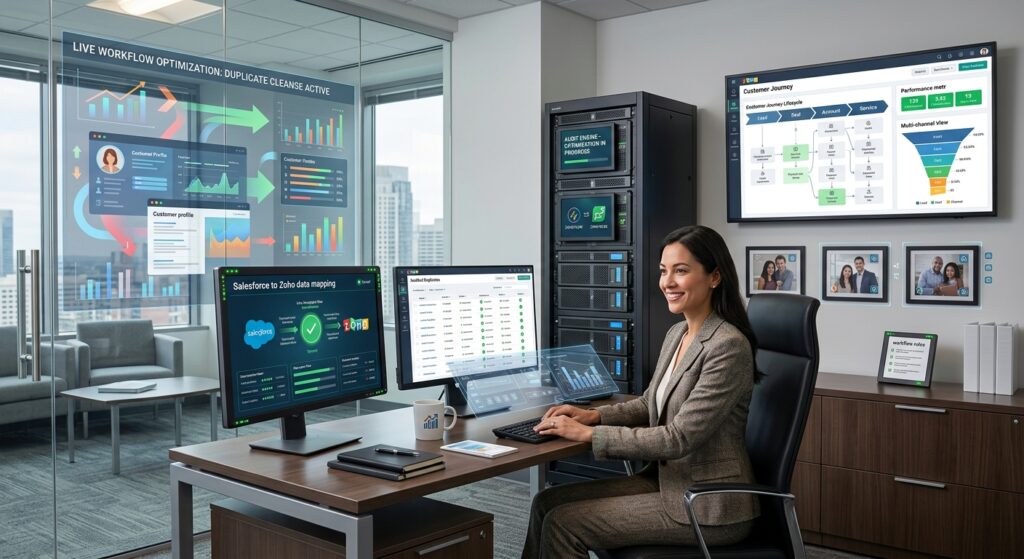
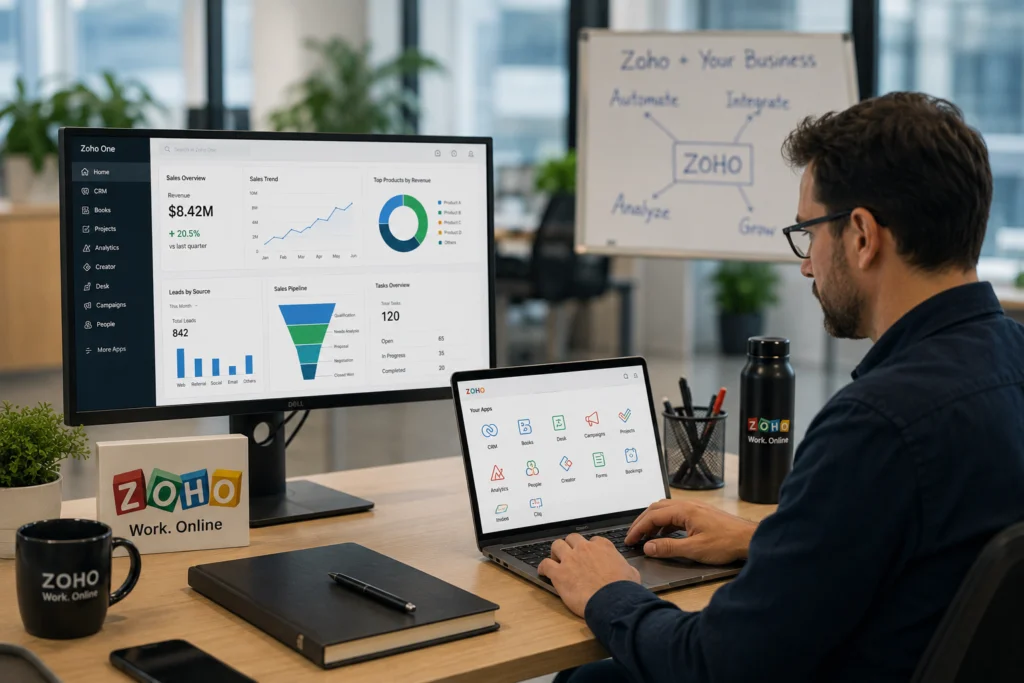
This is an illustrative scenario based on a common challenge faced by custom and made-to-order manufacturers, showing how ZillTech’s Zoho Consulting, Analytics & Reporting, and Customization & Automation services can transform a project-based production business.
Industry: Custom Industrial Equipment Manufacturing Services Highlighted: Zoho Consulting, Zoho Analytics & Reporting, Customization & Automation Tools Used: Zoho CRM, Zoho Creator, Zoho Analytics, Zoho Inventory, Deluge Scripting
The Business Profile
The Company builds custom conveyor and material-handling lines for food processing and packaging plants. Founded by a rented machine shop and now the company has grown into a 58-person operation with its own fabrication floor, in-house engineering team, and an install crew that travels to customer sites. No two orders are identical, every job starts with an engineering quote, moves through a multi-week fabrication process, and ends with on-site installation. Sales, engineering, the shop floor, and accounting all touch the same job at different points, but by early 2025 none of them were looking at the same information anymore.
Challenge
Luminet Solutions relied on a manual process to generate customer invoices from call detail records (CDRs). Every billing cycle required importing call data, calculating charges, preparing invoices, and creating recurring invoices for customers. The process was time-consuming, prone to human error, and delayed billing by up to two days each month.
The company also lacked a self-service portal where customers could review their call history, billing details, and make online payments.
The Challenge
For a project-based manufacturer at this size, a single order typically passes through five or six departments before it ships — and each handoff was losing information along the way.
- Slow, inconsistent quoting. Sales reps built quotes in a shared Excel template, manually cross-checking material costs against a supplier price sheet that was only updated monthly. Quotes took an average of five business days to turn around, and with steel prices moving as often as they did in 2024, pricing was sometimes a few weeks stale by the time a customer signed.
- No mid-project cost visibility. Job costing — materials, labor, and shop time — was reconciled by the accounting team only after a job shipped. A job that looked profitable at the quoting stage could turn out to have a thin or negative margin, and nobody found out until the final invoice was already out the door.
- Shop floor status was a phone call away. Customer service had no visibility into where an order actually stood in fabrication. When a customer called asking for an update, the rep had to walk out to the floor or radio a shift supervisor to find out — a process that could take 15–20 minutes for a single status check, more during peak production weeks.
- Reactive materials ordering. Purchasing reordered raw steel, motors, and gearbox components only after a shop supervisor noticed something was running low. On at least two occasions in the prior year, a job sat idle for several days waiting on a gearbox that could have been reordered a week earlier.
By late 2024, the company was running six to eight simultaneous jobs at any given time — nearly double what it had handled three years earlier. At that volume, these gaps stopped being background friction and started directly delaying shipments and eating into margins that had looked fine on paper at the quoting stage.
How ZillTech Approached This
ZillTech’s first step was mapping the full quote-to-ship journey — from the moment a customer requested a quote to the moment a system ships and the job is closed out — so automation got built around the company’s actual sequence of handoffs, not just individual departments in isolation.
1. Live Quoting Module Tied to Current Material Costs
A custom quoting layout was built directly in Zoho CRM, pulling current material pricing from Zoho Inventory instead of the monthly supplier sheet. When a rep builds a quote, per-unit steel, motor, and component costs populate automatically, so pricing reflects what materials actually cost that week.
2. Job Costing which Updated as the Job Progressed
Using Deluge scripting, ZillTech connects shop floor labor logging and materials draw-down directly to each CRM deal record. As hours are logged and materials are pulled from inventory against a job, projected margin recalculates automatically — instead of waiting for a post-shipment reconciliation, a project manager can see a job’s real-time margin trending by day three of a three-week build, while there’s still time to address a cost overrun.
3. A Shop Floor Status App Built in Zoho Creator
A lightweight Zoho Creator app lets shift supervisors update a job’s status (Fabrication, Welding, QA, Ready to Ship) from a tablet mounted near the assembly line, in a few taps. That status now shows directly on the CRM record, so customer service can answer a status question in the time it takes to open the account.
4. Automated Low-Stock Alerts
Deluge-based automation monitors raw material and key component stock levels in Zoho Inventory and flags purchasing when a part used across multiple active jobs — like the gearbox model that caused delays the year before — drops below a set threshold.
5. A Margin and Backlog Dashboard for Leadership
A Zoho Analytics dashboard consolidates active job margins, backlog by production stage, and on-time shipment rate into a single view the ownership team now checks every Monday morning, replacing the spreadsheet a project manager previously compiled by hand every Friday afternoon.
Why ZillTech
As an Authorized Zoho Partner, ZillTech specializes in adapting Zoho to the actual sequence of handoffs inside a business in this case, the specific path an order takes from quote to shop floor to shipment rather than a generic CRM setup that stops at “leads and deals.”
Want to see what this could look like for your production business? Schedule a free consultation to walk through your current quote-to-ship workflow.


The Results: Faster Quotes, Real Margin Visibility
- Quote turnaround cut from 5 days to under 2. Live material pricing removed the back-and-forth of manually checking supplier costs, and most quotes now go out within a day and a half of the initial request.
- Margin visibility moved from “after shipment” to “day three.” Project managers can now catch a cost overrun mid-build instead of discovering it during post-shipment reconciliation, giving them a real window to adjust scope or flag it to the customer before the job closes out.
- Shop floor status calls dropped by roughly 40%. Customer service can answer most status questions directly from the CRM record, cutting down on the interruptions that previously pulled shift supervisors off the floor.
- Material-related delays down by about a third. Automated low-stock alerts catch shortages early enough for purchasing to reorder before a job is actually blocked, rather than after — no repeat of the gearbox delay from the year before.
What Company Says About ZillTech
“We used to find out a job wasn’t profitable weeks after it shipped. Now our project managers see it happening in real time and can actually do something about it. That alone changed how we quote new work.” – Operations Director