This is an illustrative scenario based on common maintenance and tenant-request challenges faced by growing property management companies. It demonstrates how ZillTech’s Zoho team uses Zoho Consulting, Zoho Implementation, Customization & Automation and Analytics & Reporting services to connect tenant requests, vendors, owner approvals and reporting in one workflow. Company details are representative of a typical client profile and not an actual ZillTech engagement.
Industry: Property Management
Services Highlighted: Zoho Consulting, Zoho Implementation, Customization & Automation, Zoho Analytics & Reporting
Tools Used: Zoho CRM, Zoho Creator, Zoho Flow, Zoho Analytics
The Business Profile
The company was a growing property management firm looking after residential and small commercial units for several owners. The team included property managers, a maintenance coordinator, a leasing agent, an accounts person and a director who still approved most repair costs. Tenants reported problems by phone, text message, email and through a shared inbox. The coordinator tracked jobs in a spreadsheet and on sticky notes, and vendors such as plumbers, electricians and HVAC technicians were dispatched by phone.
Every person knew their own part well. Nobody could see the whole journey of a request. When a tenant asked whether someone was coming, or an owner asked what a repair had cost, the answer meant checking a phone, an inbox and a spreadsheet.
The firm didn’t need a bigger system. It needed tenant requests, vendors, approvals and reporting connected, with clear ownership of every step between a reported problem and a closed job.
The Challenge
Requests Arriving Through Every Channel: A leaking tap could arrive as a text, a voicemail or an email. Some requests were logged late and a few were never logged at all.
No Single Record per Request: Details lived in different places. The tenant’s unit, the photos, the vendor’s quote and the final invoice were rarely together, so the same questions were asked again and again.
Vendors Dispatched by Phone: The coordinator called vendors one by one. Nobody could quickly see who had been contacted, who had accepted the job and whether the work was finished.
Tenants and Owners Left Guessing: Tenants chased for updates, and owners asked about progress and cost. Each question pulled the coordinator away from managing the work. It also affects renewals: according to an industry report cited by Buildium, 31% of renters who were unsure about renewing said they would stay if their property manager were more responsive to maintenance requests.
Approvals and Costs Hard to Track: Repairs above a certain amount needed owner approval, but approvals were given by email or verbally. Later it was hard to prove who agreed to what.
Reports Built by Hand: Managers pulled numbers from several files to see open requests, response times and costs per property, and the figures rarely matched.
Our Approach
Before changing any system, ZillTech met with the property managers, the maintenance coordinator, the accounts person and the director. The goal was not to replace what worked. It was to remove retyping and chasing, and to make every handoff visible.
Discovery Before Technology
We mapped the full path from a tenant reporting a problem to a closed job, and marked every point where information was retyped, delayed or lost. The findings were written in plain language and sorted by impact, so leadership could choose what to fix first. This is the kind of work behind our Zoho Consulting engagements. The biggest delays turned out to be the moment a request was triaged and the moment someone had to chase a vendor for an update.
Clean Property and Tenant Data First
A new system only spreads bad data faster. Before setting anything up, we agreed on one rule: every property, unit, tenant, owner and vendor is created once, in Zoho CRM, and every other tool follows it. Duplicate and outdated records were reviewed and merged, naming standards were written down, and each tenant was linked to their unit and each unit to its owner. Vendors were set up by trade and service area, with their preferred contact details. We take a similar approach in our Zoho CRM cleanup case study.
Implementing Zoho CRM
ZillTech set up Zoho CRM as the single source of truth for properties, units, tenants, owners and vendors. Anyone on the team can now open a tenant record and see the unit, the owner and the related requests in one place. For a closer look at this kind of setup, see our page on Zoho CRM for Property Management.
A Custom Maintenance App in Zoho Creator
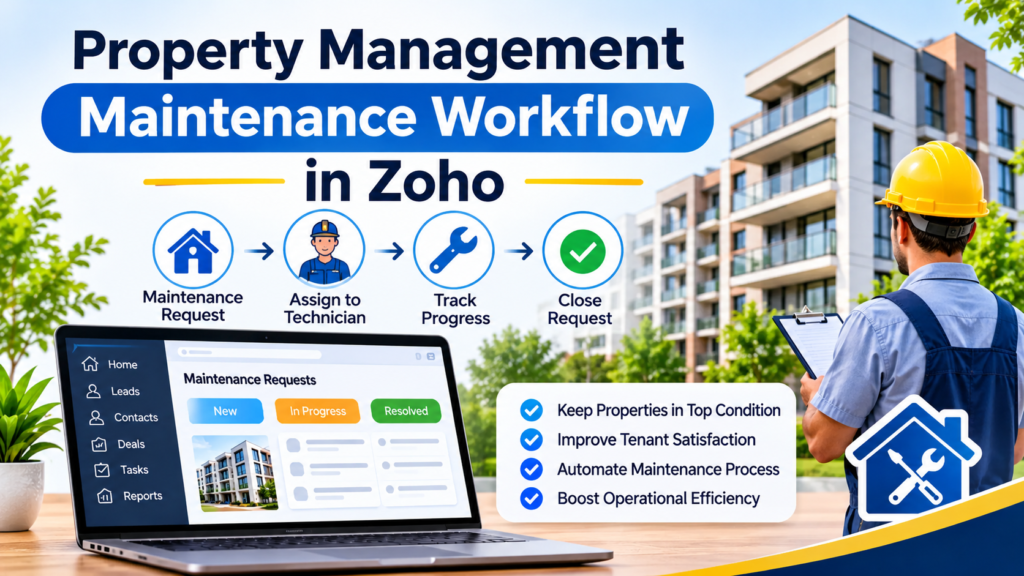
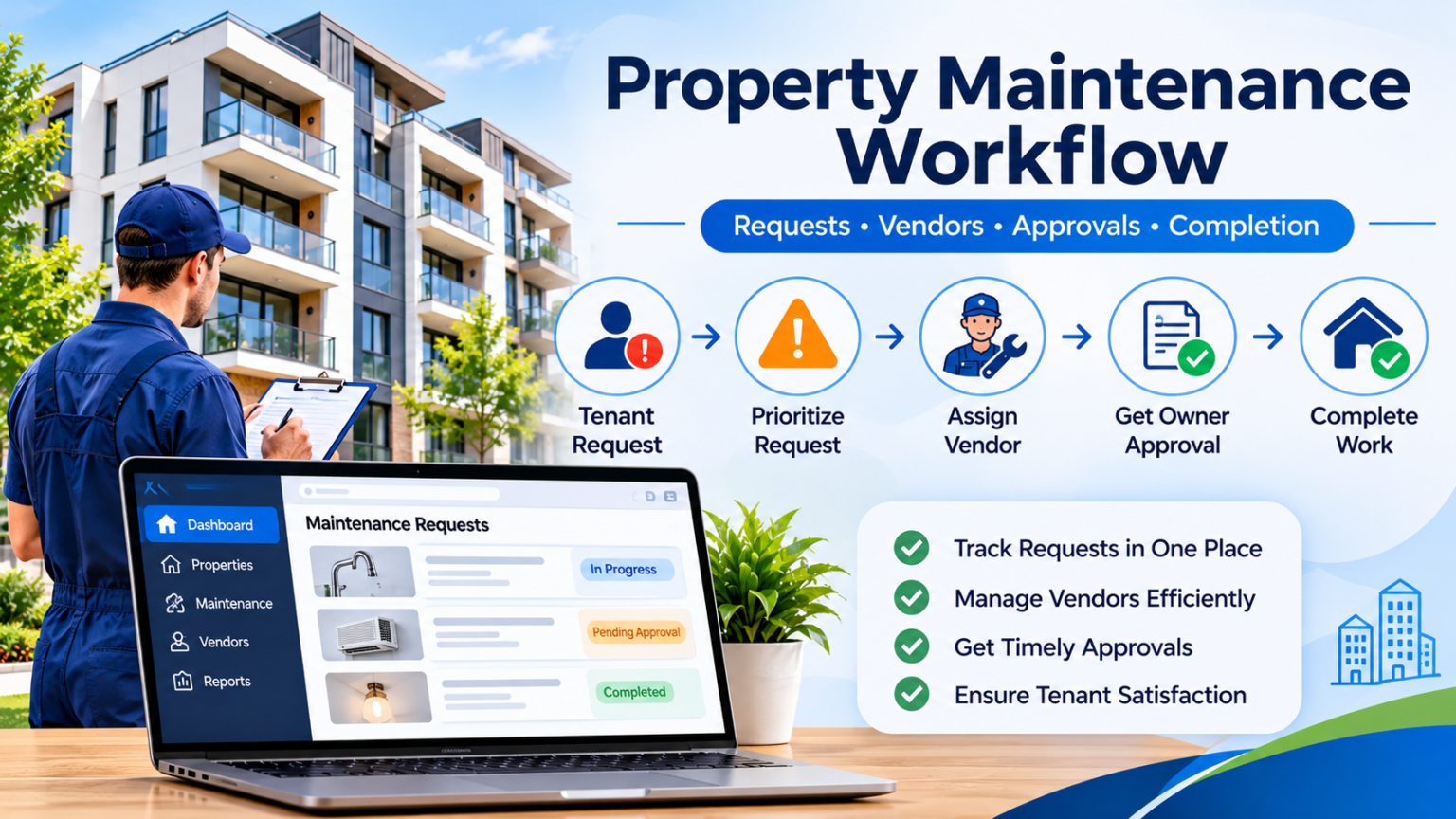
The maintenance process had steps that no off-the-shelf module matched exactly, so ZillTech built a small app in Zoho Creator. It holds the request form, the category, the priority level (emergency, urgent or routine), photos from the tenant, the assigned vendor, a cost approval step and a completion check. It connects back to Zoho CRM, so every request points to the right unit, tenant and owner. Coordinators update job status from a phone or tablet instead of a spreadsheet. Every field and stage was documented, so the team knows what each one does. For a closer look at how these apps are built, read our guide to building custom business apps with Zoho Creator. If your process needs this kind of work, see our Zoho Customization & Automation service.
Automating the Handoffs
When a tenant submits a request, they receive a confirmation and the coordinator is notified. Emergency requests are flagged straight away. When a vendor is assigned, the vendor is notified with the unit details and photos. If the estimated cost goes above the limit an owner has set, an approval request is sent to the right person, and the answer is recorded on the request. When the vendor marks the job complete, the tenant is asked to confirm, and the request closes only after that. People still make the decisions. The system just removes the waiting, the phone tag and the retyping. Zoho Flow can connect Zoho Creator records and Zoho CRM modules so that an update in one reaches the other. It is the same no-code approach we describe in our guide to lead management with Zoho Flow.
Reporting, Documentation, and Handover
A dashboard in Zoho Analytics now shows open requests by property, priority, age of request, vendor response and repeat issues per unit, side by side, built on definitions that managers, the coordinator and accounts agreed together. Because the maintenance app is built on Zoho Creator, its data syncs automatically into Zoho Analytics. Property management guidance often suggests tracking time to acknowledge, assign and close a request, plus the open backlog by property, and a dashboard like this can report on those measures too. A similar reporting approach is explored in our Zoho Analytics & Reporting work. Our guide to building your first Zoho Analytics dashboard covers the basics. ZillTech then wrote simple documentation and trained an in-house administrator, so the firm doesn’t depend on an outside developer for everyday changes.
Why It Mattered
As an Authorized Zoho Partner, ZillTech doesn’t push a rebuild for its own sake, and our Zoho CRM consultants in Texas are available for local support. We look at what you already run, fix what slows your team down, and add automation only where it helps.
Not sure which Zoho apps fit your maintenance and tenant process? Try our free Zoho App Finder, or schedule a free consultation and we’ll review your workflow first.

The Results: Clearer Requests, Faster Handoffs and Numbers That Agree
The project turned a set of text messages, inboxes and spreadsheets into a connected workflow that every team uses daily.
Requests Logged Once: Every request is created as a single record, whatever channel it came from, so nothing depends on someone remembering a phone call.
Emergencies Spotted Early: Priority is set when the request is submitted, so urgent problems reach the coordinator straight away instead of waiting in an inbox.
Vendors Tracked in One Place: Anyone can see who was assigned, who accepted and whether the work is finished, without calling around.
Approvals on the Record: Owner approvals are recorded against the request, so it is clear who agreed to what, and when.
Tenants and Owners Kept Informed: Confirmations and status updates are sent automatically, so the coordinator spends less time answering “any update?” messages.
Reports That Reconcile: Requests, response times, repeat issues and costs are shown on one set of definitions, so management meetings start with decisions rather than debates.