
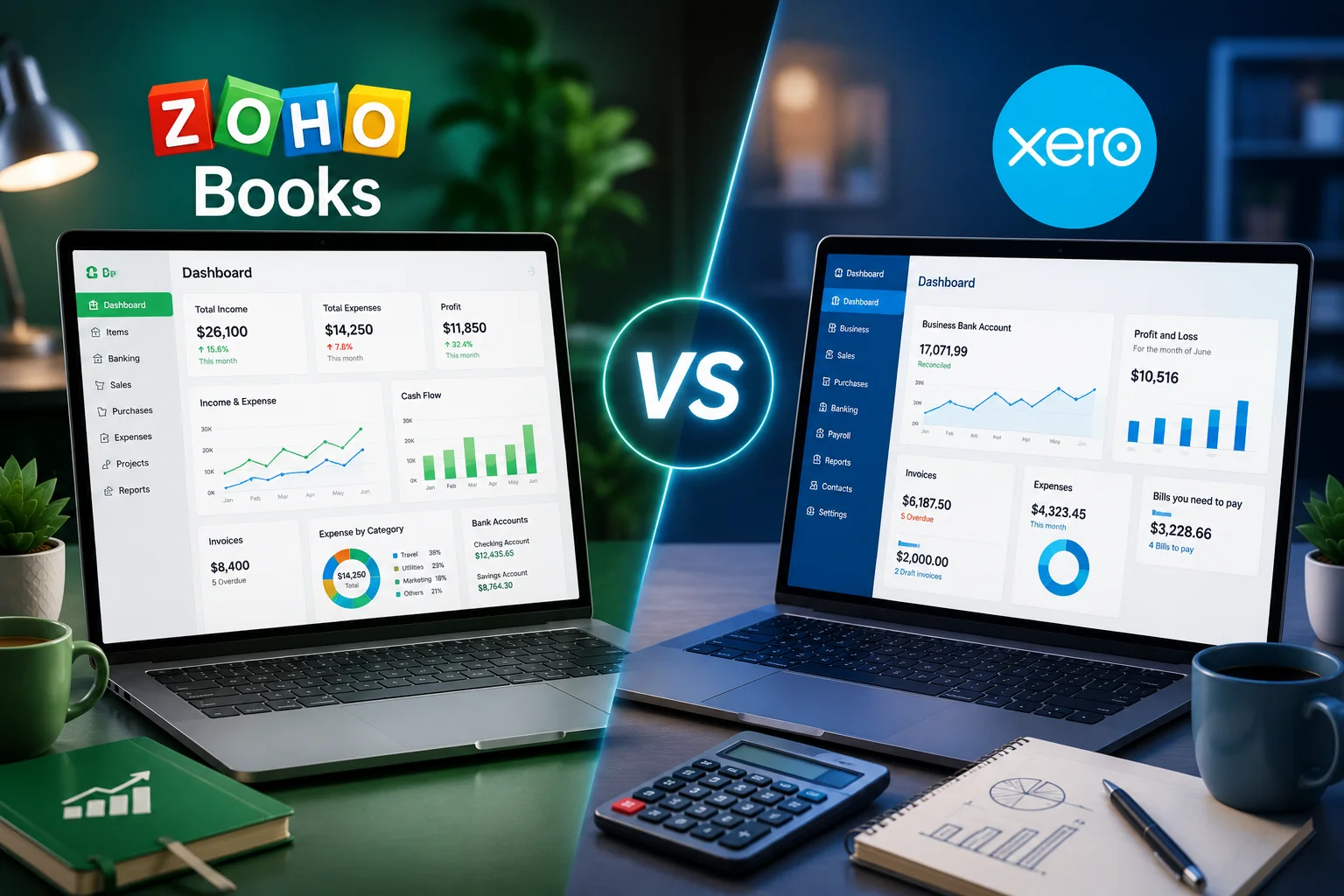
That’s the one-sentence version. Below, we break down actual 2026 pricing, feature depth, and the part most comparison articles skip what happens to your bill once your team stops being three people.
Not Sure Which Platform Fits Your Business?
Get a free side-by-side cost estimate based on your actual team size and workflows before you commit to either platform.
Schedule a Free Consultation Call
Why This Comparison Actually Matters in 2026
Most “Zoho Books vs Xero” articles compare screenshots and call it a day. But the real decision point for most businesses isn’t which dashboard looks nicer, it’s which platform’s pricing model matches how your team actually grows. Zoho Books prices by organization with capped users; Xero prices flat with unlimited users. That single structural difference can flip which platform is cheaper depending on your headcount, and almost nobody explains it clearly before you sign a contract.
There’s also the ecosystem question. If your business already runs on Zoho CRM, Zoho Inventory, or Zoho Desk, Zoho Books plugs into that stack natively. If you’re deep into a different toolchain or need one of the 1,000+ integrations Xero supports that changes the calculus entirely.
Zoho Books vs Xero: Pricing Breakdown (2026)
| Plan Tier | Zoho Books (per org) | Xero (per org, unlimited users) |
| Entry / Free | Free (1 user, under $50K revenue, 1,000 invoices/yr) | No permanent free plan — 30-day trial only |
| Starter | Standard — $20/mo ($15/mo annual) | Early — $25/mo (capped at 20 invoices, 5 bills/mo) |
| Mid-Tier | Professional — $50/mo ($40/mo annual) | Growing — $55/mo (unlimited invoices & bills) |
| Advanced | Premium — $70/mo ($60/mo annual) | Established — $90/mo (multi-currency, projects, expenses) |
| Higher Tiers | Elite — $150/mo, Ultimate — $275/mo | (No higher published tier — Established is the ceiling) |
| Extra Users | ~$2.50/user/month beyond plan cap | Included — unlimited on every plan |
The takeaway from this table alone: Zoho Books has a lower floor (a genuinely usable free plan) but a variable ceiling once you factor in per-user add-ons. Xero has a higher floor but a completely flat, predictable ceiling regardless of team size.
Not Sure Which Plan You Actually Need?
Skip the guesswork. Let us map your invoice volume, team size, and integrations to the right plan on either platform.
Request a Free Plan Assessment
The Chart Nobody Shows You: Cost as Your Team Grows
Here’s where the pricing tables above stop telling the full story. Below is what a mid-tier plan on each platform actually costs once you scale from a 2-person team to a 10-person finance team Zoho Books Professional (with per-user add-ons) versus Xero Growing (flat, unlimited users).
Monthly Cost at 10 Users: Zoho Books Professional vs Xero Growing

Zoho Books Professional (Base $50 + 7 extra seats × $2.50) $67.50/mo
Xero Growing (Flat rate, unlimited users) $55/mo
At 3 users or fewer, Zoho Books is almost always the cheaper option. Somewhere around 5 users, the per-seat fee erodes that advantage, and by 6 users, Xero’s flat pricing pulls ahead even though its sticker price looked higher on day one. This crossover point is the single most useful number in this entire comparison, and it’s the first thing we calculate with clients before recommending either platform.
Feature Depth: Where Each Platform Actually Wins
Zoho Books tends to win on:
- Price at small team sizes, plus a genuinely usable free tier for pre-revenue businesses.
- Native integration with Zoho CRM, Inventory, Desk, and the broader Zoho One suite.
- Built-in workflow automation and client portal at lower price points than Xero’s equivalent tier.
Xero tends to win on:
- Unlimited users on every plan, no per-seat penalty as your team grows.
- A much larger third-party app marketplace (1,000+ integrations) for niche industry tools.
- Stronger multi-currency and project-tracking depth at the Established tier, which appeals to businesses with international clients.
Where both fall short: neither includes payroll in the base price for most regions expect to add Zoho Payroll or a Xero payroll add-on separately, and both platforms’ advanced reporting eventually pushes larger businesses toward a dedicated BI tool.
Zoho Books vs Xero 2026: Which Should You Choose?
Use this quick logic if you want the short version:
- Choose Zoho Books if: you’re a small team (1-5 people), already use other Zoho apps, or need a real free tier before you’re earning revenue.
- Choose Xero if: your team is growing past 6-8 people, you need deep third-party integrations, or you want one flat, predictable bill regardless of headcount.
- Choose neither, get help instead, if: you’re not sure which invoice volume, user count, or add-ons you’ll actually need guessing wrong here is an expensive mistake to unwind later.
Getting Started: A Quick Decision Checklist
- Count your actual users: not just today’s headcount, but where you expect to be in 12-18 months.
- List your must-have integrations: CRM, inventory, payroll, payment gateways and check both platforms’ native support before assuming either “just works.”
- Estimate your invoice and bill volume: this determines whether Zoho Books Standard or Xero Early will actually be enough, or whether you need the next tier up from day one.
- Run the crossover math: multiply your expected user count by each platform’s per-seat or flat cost over 12 months, not just the monthly sticker price.
- Get your data migration plan sorted first: switching accounting platforms with messy historical data is far riskier than switching CRMs.
How a Zoho Consulting Partner Helps You Decide (and Migrate)
Choosing between Zoho Books and Xero isn’t just a pricing exercise, it’s a decision about which ecosystem your finance data will live in for years. A partner who’s implemented both can map your actual invoice volume, integrations, and growth trajectory to the right platform, then handle the technical migration so historical records, tax settings, and reconciliations transfer cleanly instead of becoming a spreadsheet mess.
Ready to Make the Right Call for Your Business?
Let’s run your numbers against both platforms and set up the one that actually fits not just the one with the flashier homepage.


