
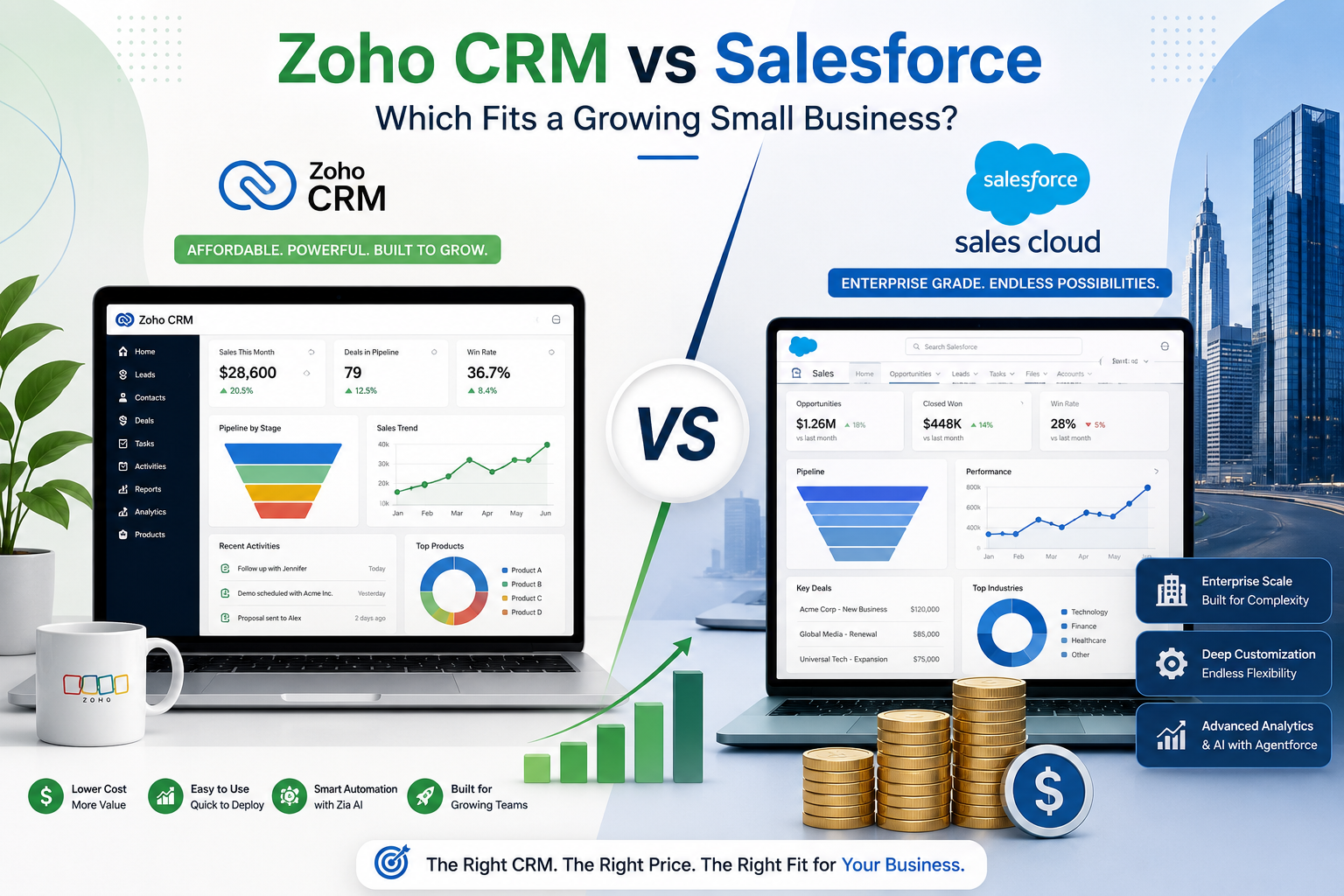
We work inside Zoho CRM setup, integration, and automation projects every week, so this is not a neutral ‘both are great’ piece. It is grounded in current 2026 pricing and a framework you can actually use, not a features list copied from each vendor’s homepage.
Not sure which tier fits your team size?
Not sure which tier fits your team size? Get a free 20-minute CRM assessment. We will look at your current sales process and tell you exactly which platform and tier actually fit, no sales pitch attached.
Pricing at a Glance
Zoho CRM’s paid plans run from $14 to $52 per user per month on annual billing. Salesforce’s Sales Cloud plans (branded Agentforce Sales in 2026) start at $25 and climb to $550 per user per month once you add its AI tier. For a small business with a lean budget and a straightforward sales process, that gap alone often settles the decision before features enter the conversation. For a business that already runs on a complex, highly customized sales motion, Salesforce’s depth can justify the premium.
Pricing Side by Side
Here is how the two platforms compare tier by tier, based on current annual billing rates.
| Tier level | Zoho CRM | Salesforce Sales Cloud |
| Entry paid tier | Standard, $14/user/month | Starter Suite, $25/user/month |
| Growth tier | Professional, $23/user/month | Pro Suite, $100/user/month |
| Advanced tier | Enterprise, $40/user/month | Enterprise, $175/user/month |
| Top tier | Ultimately, $52/user/month | Unlimited, $350/user/month |
| AI-focused tier | Included progressively via Zia | Agentforce 1 Sales, $550/user/month |
Picture this as a visual: if you plotted these ten prices on a bar chart, the four Zoho bars would sit clustered tightly together at the low end of the scale, each one only a little taller than the last. The five Salesforce bars would climb far more steeply, with the jump from Pro Suite to Enterprise alone (roughly $75 per user) already larger than Zoho’s entire range from Standard to Ultimate. By the time you reach Salesforce’s Agentforce 1 Sales bar, it would tower over every other bar on the chart at more than ten times the height of Zoho’s entry tier.
What You Actually Get at Each Stage
Price alone does not tell you whether a plan can run your business. Here is what typically matters at each growth stage.
Starting (1 to 10 users, simple pipeline)
Zoho’s Standard plan already includes multiple pipelines, custom dashboards, and mass email at $14 per user. Salesforce’s comparable Starter Suite, at $25 per user, covers lead and account management but leaves out automation and forecasting until you move up a tier. For a small team just getting a sales process on paper, Zoho tends to cover more ground at this price point, especially if spreadsheets and disconnected tools are already slowing your team down.
Scaling a Team (10 to 50 users, structured process)
This is where the real divergence starts. Zoho’s Professional tier ($23) adds Blueprint, its visual process management tool, plus validation rules and inventory management, well below Salesforce’s Pro Suite ($100), which is the first Salesforce tier to unlock real customization and forecasting. Teams choosing Salesforce here are usually paying for a platform built to support far more complex org structures than a 10- to 50-person team typically needs yet. This is also the stage where structured outreach sequencing starts to matter more than raw feature count, and Zoho’s Blueprint and Cadence tools are built specifically for that.
Advanced Automation and AI
Both platforms now bundle AI assistants (Zia for Zoho, Agentforce for Salesforce), but they arrive at very different price points. Zoho folds AI capability progressively into its Enterprise and Ultimate tiers, and its Deluge scripting layer lets you build custom automations and integrations without waiting on a vendor roadmap. Salesforce isolates its full agentic AI tier into Agentforce 1 Sales at $550 per user per month, a cost that only makes sense once a sales org is large enough and standardized enough to put that automation to consistent use.
A Real World Scenario: 10 Person Sales Team
Numbers are easier to weigh against each other with an actual team size attached. Here is what a 10-person sales team pays annually on a mid-tier plan from each platform, billed annually.
| Platform | Plan | Cost per user/month | Annual cost (10 users) |
| Zoho CRM | Professional | $23 | $2,760 |
| Zoho CRM | Enterprise | $40 | $4,800 |
| Salesforce | Pro Suite | $100 | $12,000 |
| Salesforce | Start | $175 | $21,000 |
At matching automation depth (Zoho Enterprise against Salesforce Pro Suite), the gap already sits above $7,000 a year for a 10-person team. That gap widens every time headcount grows, which is exactly why the choice matters more the earlier you make it, not less. It also does not yet include the reporting layer most growing teams eventually need; a platform like Zoho Analytics & Reporting can be added to a Zoho CRM setup at a fraction of what an equivalent Salesforce reporting add-on costs.
Where Salesforce Still Wins
None of this makes Salesforce the wrong choice for every business. Salesforce’s advantage shows up clearly in a few specific situations:
- Deep multi-cloud needs: Businesses that need Sales, Service, and Marketing Cloud tightly unified around one enormous data model.
- Complex forecasting: Opportunity splits and consumption-based forecasting are stronger in Salesforce’s higher tiers.
- A large existing AppExchange investment: If a business already has significant tooling built on Salesforce’s ecosystem, switching costs can outweigh the price gap.
For a business already operating at that scale, Salesforce’s cost is a platform investment, not overhead.
A Simple Decision Framework
Before comparing another feature list, answer these four questions:

- How many users need a license today, and in 12 months?
Small gaps in per-user cost become large gaps fast as headcount grows. - Does your sales process need heavy customization now, or standard pipelines?
Zoho’s Standard and Professional tiers cover most standard sales motions without paying for capacity you are not using yet. - Do you already run other business software on one ecosystem?
A business already using Zoho Books, Desk, or Projects gets compounding value from staying on Zoho One and can automate far more with a handful of hidden Zoho features most teams never turn on.The same logic applies if you are already deep in Salesforce’s ecosystem. - Who is actually going to configure and maintain this?
Salesforce’s flexibility comes with steeper implementation and admin overhead. Zoho’s lower entry cost still needs proper setup to pay off, which is usually where a Zoho consulting partner earns its fee back quickly.
Frequently Asked Questions
Is Zoho CRM actually cheaper than Salesforce, or does it just look that way on the pricing page?
It is genuinely cheaper at every comparable tier. Zoho’s top tier (Ultimate, $52/user/month) still costs less than Salesforce’s entry tier once you account for the features Salesforce holds back until Pro Suite and above. The gap holds up even after factoring in typical add-ons.
Can a small business switch from Salesforce to Zoho CRM without losing data?
Yes, in most cases. Zoho CRM supports importing contacts, deals, and historical activity from Salesforce exports. The harder part of a migration is usually rebuilding custom automations and reports to match how your team already works, not the raw data transfer itself.
Does Zoho CRM include AI features, or is that a paid add-on?
Zoho’s AI assistant, Zia, is built into the Enterprise and Ultimate tiers rather than sold as a separate add-on. This differs from Salesforce, which isolates its full AI capability into the significantly more expensive Agentforce 1 Sales tier.
How long does a typical Zoho CRM implementation take for a small team?
For a 10-to-20-person team with a standard sales process, a properly scoped Zoho CRM setup, including pipeline configuration, automation, and basic reporting, typically takes a few weeks rather than months. For a deeper breakdown of the process, see our CRM implementation guide. Salesforce implementations of comparable scope usually take longer given the platform’s added configuration depth.
Is Salesforce ever worth the extra cost for a small business?
Occasionally, yes. If a small business is scaling quickly toward enterprise complexity, already has significant Salesforce tooling in place, or needs forecasting depth that Zoho does not match, the premium can be worth paying. For most small businesses still building out a standard sales process, though, that complexity is not yet needed.
Conclusion
For most small and mid-sized businesses still building their sales process, Zoho CRM offers a better price-to-capability ratio, especially in the first few growth stages, when Salesforce’s cost climbs faster than most teams’ needs. Salesforce earns its premium once a business has outgrown standard pipelines and needs the depth of a fully built-out enterprise platform.
The right answer depends on where your team sits today, not on which platform has the bigger name.
Ready to stop guessing and see the real numbers for your team?
Talk to our team for a free consultation , or contact us directly. We will walk through your current sales workflow and show you exactly what a Zoho CRM setup would cost and deliver for your business, with no obligation.


