
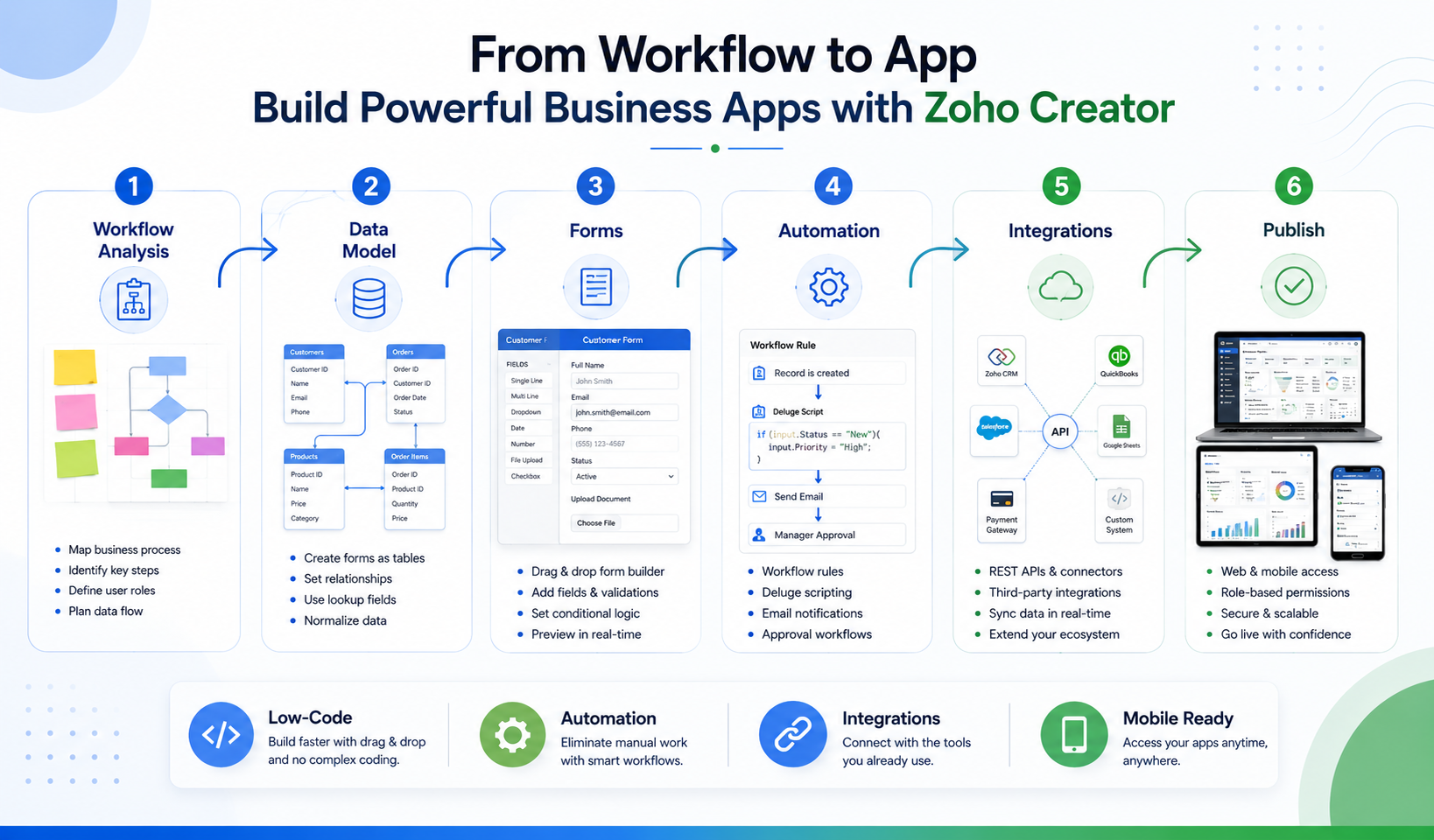
Thinking about building a custom app for your business?
Schedule a free consultation with our Zoho Creator specialists to scope it out before you start building.
That one line answer covers the mechanics, but the real value of Zoho Creator is in how it changes the way a business operates day to day. Below is a full walkthrough of the process, the decisions that matter at each stage, and where teams commonly get stuck.
What Zoho Creator Actually Is
Zoho Creator is a low code application development platform. It sits between two extremes that most businesses are familiar with: spreadsheets, which are flexible but break down at scale, and fully custom software, which is powerful but expensive and slow to change. Creator lets a business analyst or operations lead build a working internal tool, such as an inventory tracker, a client intake system, or a maintenance log, without waiting on a development team for every small change.
This matters most for companies that have already outgrown spreadsheets and generic tools but do not have the budget or timeline for a fully custom build. Creator gives them a middle path that still holds up as the business grows.
Step 1: Map the Workflow Before Touching the Builder
The most common reason a Zoho Creator project underperforms is that the build starts before the process is understood. Before opening the app builder, write out:
- Who submits data and at what point in the process
- What decisions or approvals happen after submission
- What other systems need to receive or send that data
- Who needs to see reports, and how often
This is the same discipline used in broader business process automation projects. Skipping it leads to apps that technically work but do not match how people actually do their jobs, which is why adoption often fails even when the build itself is technically sound.
Step 2: Design the Data Model
Every Zoho Creator app is built around forms, and every form is a table under the hood. Getting this structure right early saves significant rework later. A few practical rules:
- One form per distinct business object (a customer, an order, an asset) rather than one giant form trying to capture everything.
- Use lookup fields to connect related forms instead of retyping data.
- Use subforms when one record naturally contains a list of line items, such as an invoice with multiple products.
Subforms in particular are underused by teams new to the platform, and they solve a lot of the “how do I fit a table inside a form” problem that trips people up early on. For a detailed breakdown of how subforms behave and where they save the most time, see our in-depth guide.
Step 3: Build the Forms and Reports
Once the data model is settled, the actual building goes quickly. Zoho Creator’s drag and drop form builder covers standard field types (text, date, dropdown, file upload, signature) along with conditional visibility, so fields can appear or hide based on earlier answers. Reports are generated automatically from form data, and can be filtered, grouped, and shared with specific user roles.
This is where the platform earns its “low code” label. A functional app, including forms and basic reports, can realistically be built in a few hours by someone with no programming background. This kind of accessibility is a big part of why Zoho Creator has become a popular choice for non-technical teams building their own internal tools.
Step 4: Add Automation and Business Logic
This is where a basic form turns into an actual business application. Zoho Creator supports automation at a few levels:
| Automation Type | What It Does | Typical Use Case |
| Workflow Rules | Trigger an action when a record is created or updated | Send a notification when a new lead form is submitted |
| Schedules | Run a task at a set time or interval | Generate a weekly summary report every Monday |
| Deluge Scripting | Custom logic written in Zoho’s scripting language | Calculate pricing tiers based on multiple fields |
| Approval Workflows | Route a record through defined approval stages | Purchase requests above a set amount need manager sign off |
Deluge is the part that separates a simple digital form from a real operational system. It handles conditional logic, calculations, and record updates across forms, and it is close enough to plain language that most technical users pick it up quickly. Teams that feel limited by basic CRM automation often move to this level of custom logic once they realize standard automation tools stop being enough for their process.
Step 5: Connect It to the Rest of the Business
An app that only exists inside Zoho Creator is useful, but an app that talks to the rest of the business software stack is far more valuable. Creator supports integration through its own connectors and through REST APIs, which means data can flow between Creator and accounting software, external CRMs, or custom systems.
Setting this up correctly does require understanding the Zoho API structure and authentication, particularly for businesses connecting Creator to systems outside the Zoho ecosystem. This is usually the point where a business decides whether to keep building internally or bring in outside implementation support.
Step 6: Test With Real Users, Not Just the Builder
A workflow that makes sense to the person who built it does not always make sense to the person using it daily. Before rolling an app out fully:
- Have someone from the actual team walk through the app on a real scenario
- Check the app on mobile, since Creator apps are used from phones and tablets as often as desktops
- Confirm permission levels are set correctly so people only see what they should
Where Teams Typically Get Stuck
The chart below reflects where implementation time tends to go on a typical mid sized Zoho Creator project, based on common project patterns.
| Data Modeling | 24% | |
| Form and UI Build | 20% | |
| Automation and Logic | 32% | |
| Integrations | 12% | |
| Testing and Rollout | 12% |
Time spent by project phase
Automation and logic consistently take the largest share of time, which lines up with the earlier point: the form building is fast, but the business logic is where the real work happens. This is also where a lot of small, high value shortcuts exist. Zoho Creator has a growing set of AI assisted build tools that can speed up form and logic creation, and it’s worth reviewing the newer AI tools in Zoho Creator before building everything manually.
When to Build In House vs Bring in a Consultant
Zoho Creator is genuinely accessible to non-developers, but that does not mean every project should be built without outside help. A few signals it is worth bringing in a consultant:
- The app needs to integrate with several external systems at once
- Multiple departments will use the same app with different permission needs
- The business has tried building it internally and hit a wall with Deluge scripting or data structure
- The app is replacing a system that is core to daily operations, where downtime or errors are costly
Businesses in construction, manufacturing, and education tend to hit these walls earlier than others because their processes involve more moving parts and more field-level data collection. There’s a good overview of how Creator gets adapted for these more complex industries, which is worth reading before scoping a build.
For businesses that decide to bring in support, Zilltech’s Zoho implementation services and customization and automation work are built around exactly this kind of project, taking a business from a workflow on paper to a working, integrated application.
One example of this in practice is a case study on transforming business operations through custom Zoho application work.
A Few Features Worth Knowing Early
Some Zoho Creator capabilities are easy to miss when first learning the platform but end up saving a lot of time later, including scheduled functions, multi language form support, and offline mobile data entry that syncs once a connection is restored. A broader list of these is covered in this rundown of Zoho features that save hours of manual work every month.
Final Thoughts
Zoho Creator works best when it is treated as a process tool first and a technical tool second. The building itself, forms, fields, reports, is the easy part. The value comes from mapping the real workflow accurately, structuring the data model so it can grow, and using automation to remove the manual steps that were slowing the team down in the first place.
If you’re planning a build and want a second opinion on its scope or structure before committing time and resources, ZillTech’s Zoho consulting team regularly reviews projects like these and can help you avoid the most common early mistakes. If you’d like to learn more about the people behind the work, visit our About page. When you’re ready to discuss your requirements, Book Your Free Zoho Creator Consultation to talk through your specific use case.


